
CCMP HISTORY
Building the fight for comprehensive health care.

FOUNDING OF CCMP
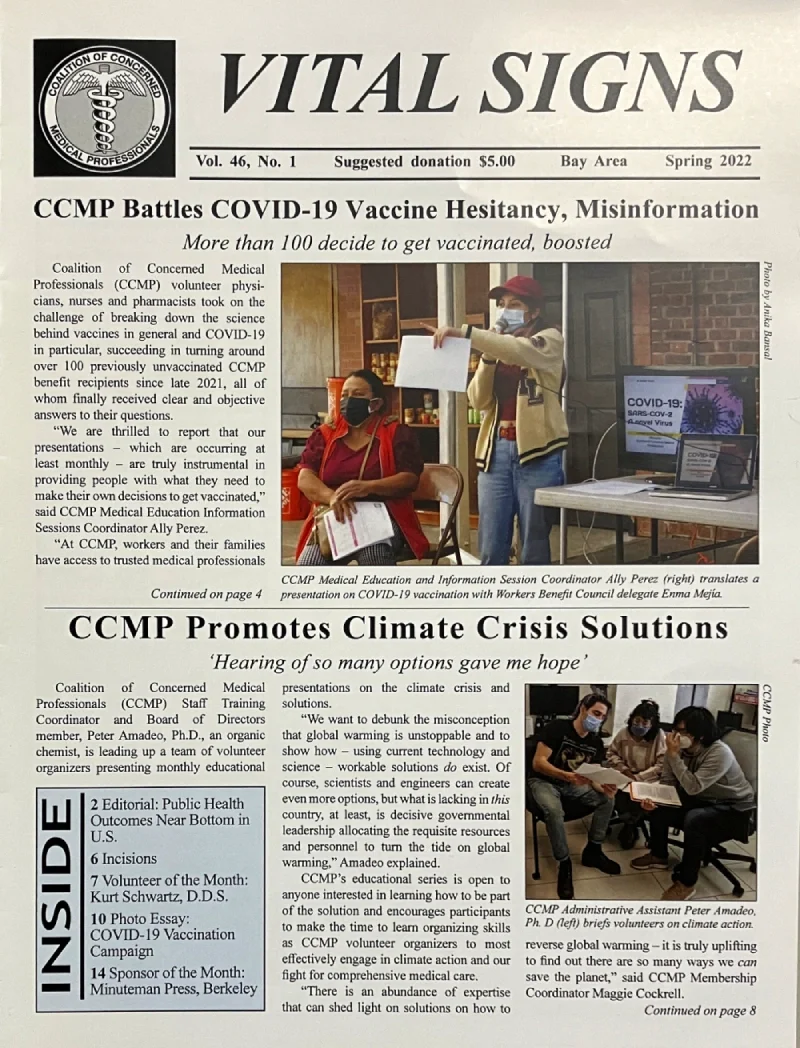
CCMP was founded in the Bay Area by a group of medical professionals in 1976, growing out of the efforts of low-income service workers and domestic workers to build an independent, grassroots labor organization capable of ending their poverty conditions. Obtaining adequate health care was a chief obstacle identified by many workers in their efforts to both survive and organize. Volunteers and members of associations of workers began to recruit medical professionals to assist with addressing some of the pressing problems these workers faced, including occupational injuries, poor living conditions, inadequate food, as well as untreated and undiagnosed illnesses.
CCMP defined itself by its commitment to comprehensive health care for low-income workers and other medically uninsured workers. CCMP’s approach to organizing its preventive medical benefit distinguished itself from that of the so-called “free clinics” that cropped up in the 1970s by advocating for the highest standards of healthcare. CCMP denounced the practice of treating the poor as second-class citizens, as well as the false mentality that any type of health care is better than none at all. CCMP also distinguished itself by its policy of refusing to accept government funding or any funding with strings attached; CCMP has always maintained its independence to fight government policies that are harmful to low-income workers.
Many of the initial medical benefit requests were for foot (podiatric) care and back problems for benefit recipients who were domestic and in-home attendant care workers. CCMP then added general medical sessions at which primary care doctors provided preventive care. Over the years, as CCMP has grown, its benefit program has grown to meet the immediate needs of its benefit recipients while fighting for long-term change.

IMMUNIZATION FIGHT
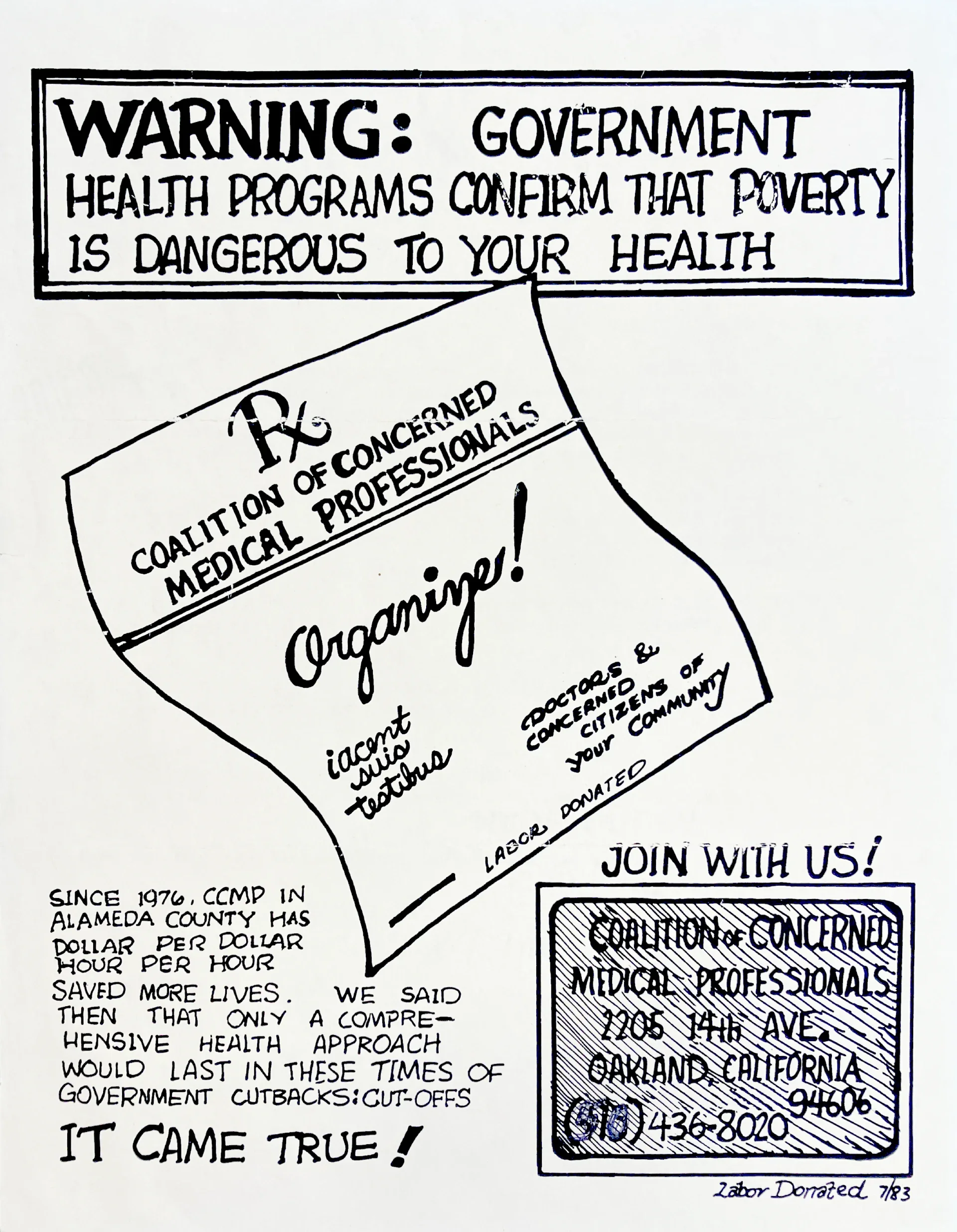
With the passage of Proposition 13 in 1978, a cap was imposed on raising property taxes except when a piece of real estate changed hands, giving major tax breaks to large real estate owners. At the same time, the federal government had reduced its funding for state public health services, which in turn led to the State of California reducing its funding to counties. Both factors led Alameda County to cut back on health services, including immunizations for children. As a result, thousands of children were left unimmunized, with 2,700 banned from attending school and another 9,000 in jeopardy of also being ejected. Through the course of a speaking engagement and massive outreach campaign, CCMP garnered support from physicians and community members to begin well-child sessions to deliver care and vaccines to low-income children as well as coordinate an advocacy campaign to demand the Alameda County Public Health Department take responsibility for immunizing the county’s children. By 1983, the immunizations were restored.

MANAGED CARE & HEALTH CARE RATIONING
In the wake of the U.S. changing from a production economy to a service economy, the federal government cut funding for social programs such as Medicaid and Medicare. Massive cuts began in the 1970s. In the 1990s, two forms of cuts that the U.S. government implemented were health care rationing and Managed Care.
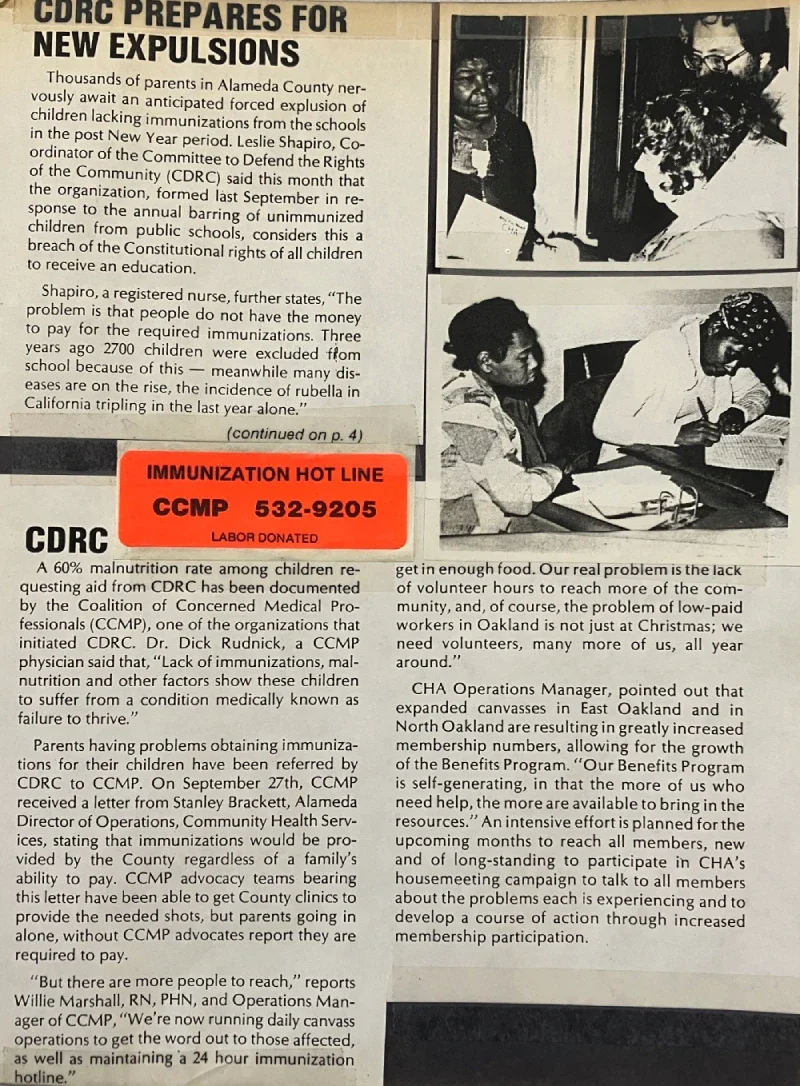
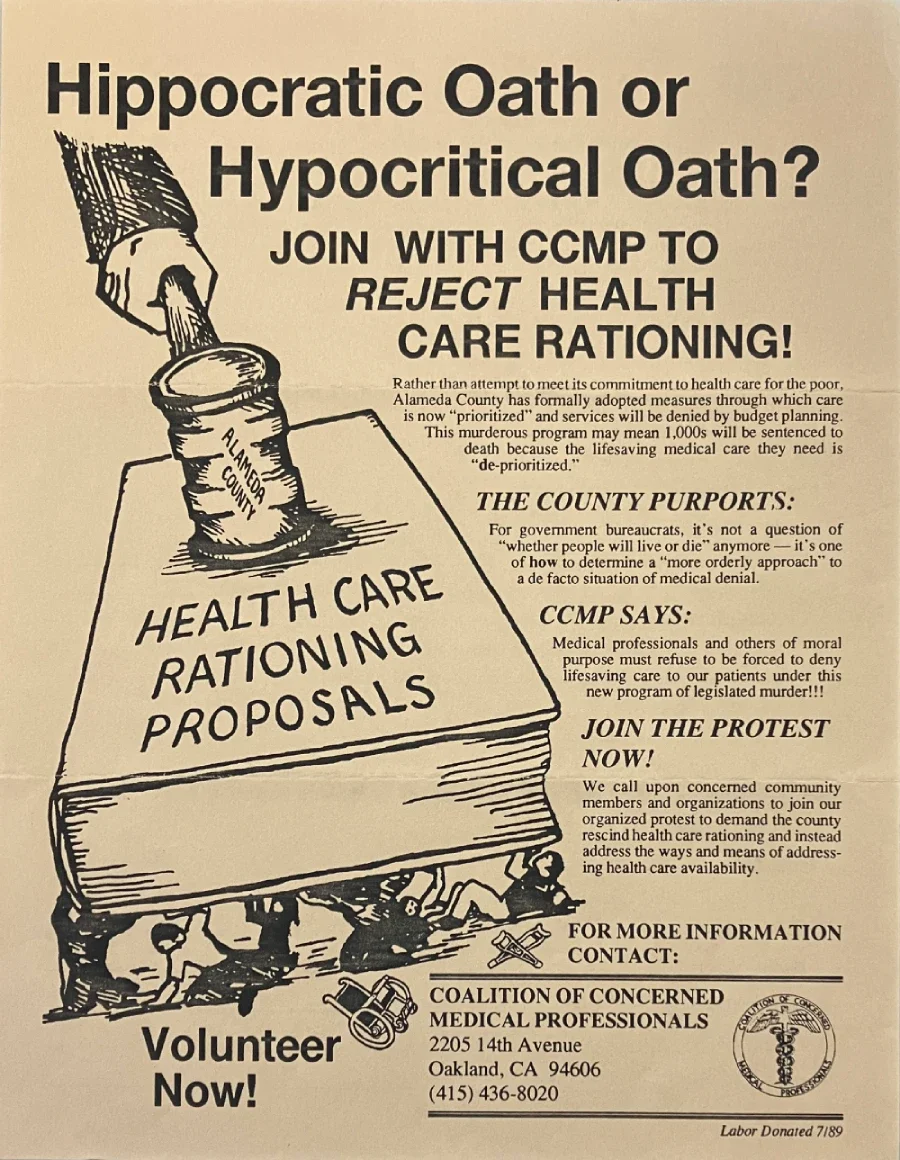
Health care rationing was when the state made a list of priorities on what procedures they would cover until they ran out of the allotted money for the year. The list being proposed by government bodies made clear that the prioritization was not based upon what was most important to maintain life for the population, but on cost. CCMP initiated state-wide speaking engagement, letter writing and petition campaigns, phone calls, outreach on the streets, arm’s-length discussions in doctors’ offices, leafletting in front of hospitals and going to the offices of state legislators to organize opposition to these bills and was able to stop it first at the county and then state level.
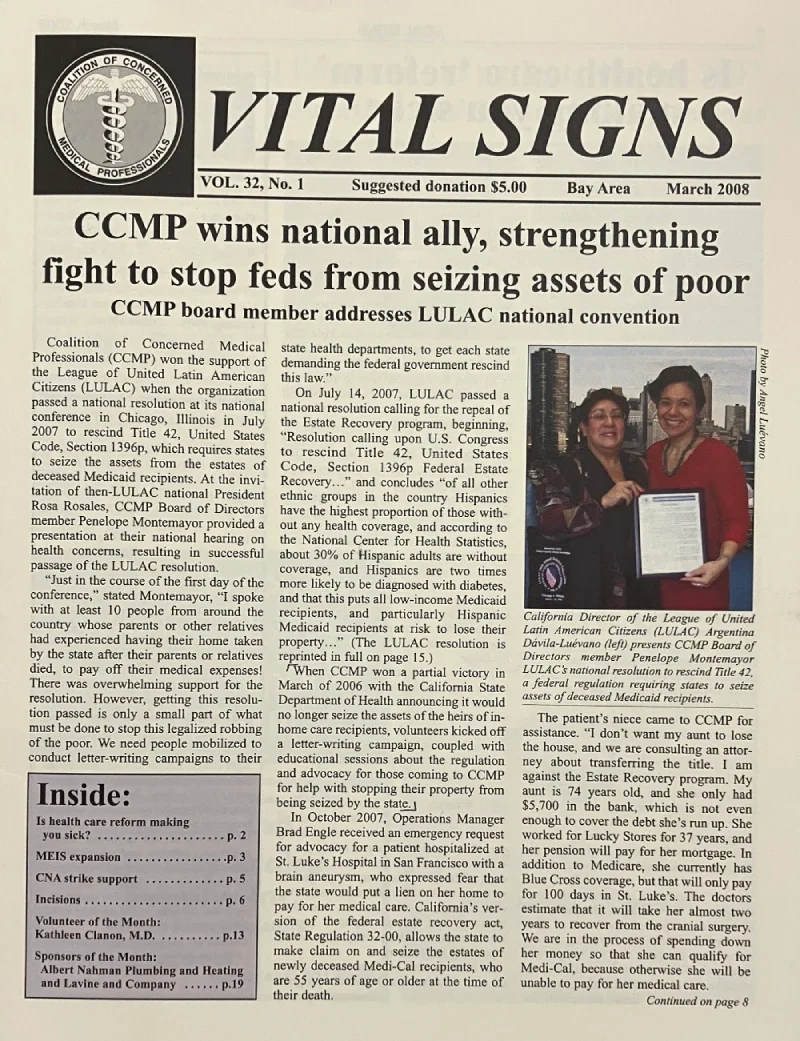
At the same time, the State of California was putting forward Managed Care as the status quo for all medical administration, which meant our tax dollars are collected by the government and given to private health insurance companies to manage. The insurance companies then have tremendous decision-making power in how to administer those dollars, which results in large profits at the expense of care for the poor. As a result, from 2014-2016, after the passage of the Affordable Care Act (ACA), private insurance companies made $5.4 billion in profits from managing Medi-Cal plans.

DR. JAMES EICHEL BECOMES MEDICAL DIRECTOR
In 1990, James Eichel, M.D., a family practice physician, began volunteering at CCMP general medical sessions. He also actively participated in CCMP’s campaign to inform low-income residents about the dangers of communicable diseases, joining CCMP teams on door-to-door canvasses and neighborhood house meetings. He became CCMP’s Medical Director in 1995.

MEDI-CAL SEIZURE OF ASSETS
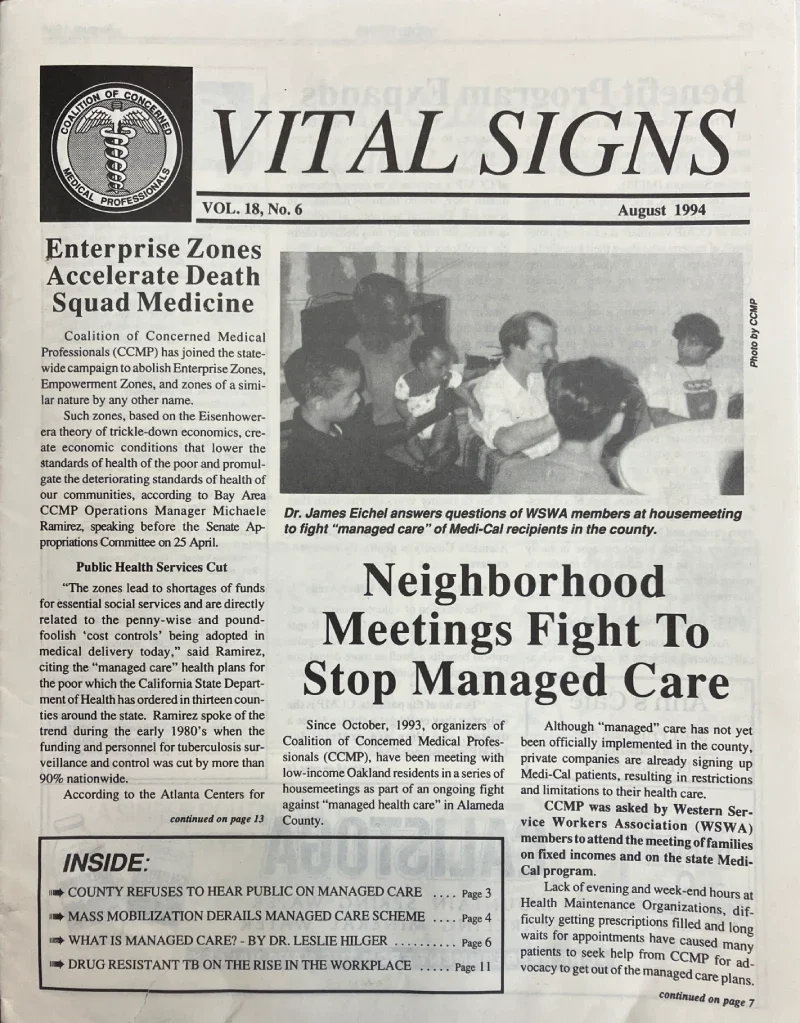
In 2005, California Governor Arnold Schwarzenegger began to aggressively recoup money from estates of deceased Medi-Cal recipients. The Estate Recovery Unit was seizing assets of approximately 4,000 deceased Medi-Cal recipients per year, depriving their heirs of approximately $50 million while, on the other hand, the state provided huge tax breaks to subsidiaries of multinational corporations operating in California. CCMP teamed up with the League of United Latin American Citizens (LULAC) to engage in a letter writing and speaking engagement program. CCMP won partial victories throughout the decade, and in 2017 the state had its ability to seize the assets of deceased Medi-Cal recipients limited under the law.

CCMP GETS A PERMANENT HOME
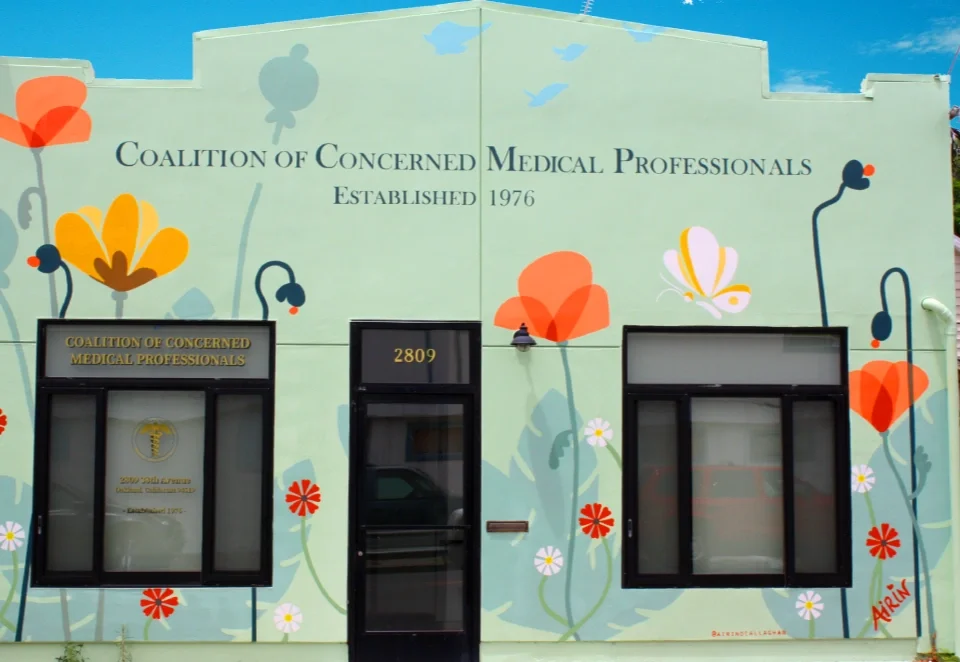
CCMP started a campaign to find a permanent office in 2014. CCMP enlisted the expert assistance of long-time Oakland realtor David Valva of Valva Realty who donated his services, along with many other CCMP volunteers and supporters who joined the search. Architect and Senior Principal and Director of Healthcare Design of HOK, William Roger, F.A.I.A., A.C.H.A. personally searched for an appropriate office that he could transform into a permanent home for CCMP with his architectural design. When CCMP found the office, it was in an unfinished condition. CCMP organized a 100% all-volunteer, completely donated renovation that made it possible to have the office it has today. This included support from one of the largest construction companies on the West Coast, Hathaway Dinwiddie, the result of a connection from the Chair of Academy of Art University, Dr. Elisa Stephens.


COVID-19 PANDEMIC RESPONSE
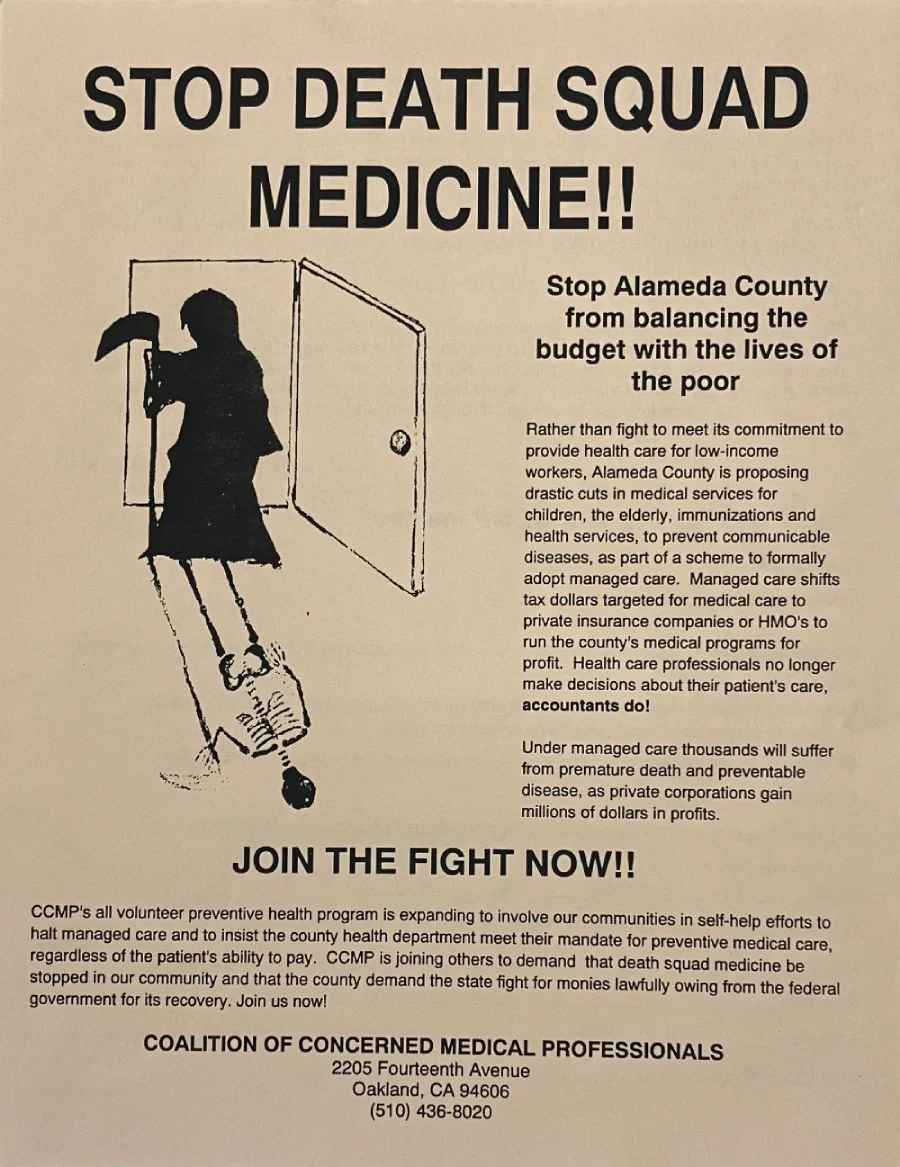
During the COVID-19 pandemic, not only did CCMP never shut down our operations for a single day, but CCMP volunteer organizers went on the offensive, conducting phoning campaigns to reach out to past benefit recipients to find out how they were doing, ask if they or their family members had any COVID symptoms, and to offer assistance with access to COVID testing, medical treatment, advocacy to secure resources to enable one to quarantine if needed and, once available, COVID vaccinations. CCMP volunteers and member physicians phoned and went on door-to-door canvasses to reach those most in need of intervention to prevent onset of serious complications, and to prevent avoidable deaths. CCMP conducted a series of Medical Education & Information Sessions to inform the community about COVID and vaccines. CCMP also launched a call-in and letter writing campaign to demand the Alameda County Board of Supervisors deal with the ramifications of COVID-19 on low-paid workers. This included a stipend for low-income workers who did not qualify for unemployment benefits due to federal labor laws. As a result, the county announced a $22 million stipend program. CCMP volunteers then did case-by-case advocacy to ensure those who qualified got access to the funds.